
New Years Resolution or Reframing Your Story
By Calvin Harris H.W., M
Happy New Year to you… some of you have come up with New Year's Resolutions. I have come up with the idea that instead of Resolutions, to do a “Reframe”, that is a cognitive reappraisal of our story for the next year.
I was surprised to get inspiration for this, as well as to be reminded of some life lessons through two films that I watch at the close of 2025.
Life lessons that somehow get ignored or forgotten but were brought back to me in the last weekends of December 2025.
Watching the films, I was reminded of that phrase: "All I Really Needed to Know I Learned in Kindergarten" Well, it was one of those moments, Yep, those lessons in memory that can come flooding back to you from elementary school years.
The two films gave a realignment of a fairy tale about a place called Oz. Now Oz was a place I was introduced to during my elementary school years. The original story was about what happened when a circus traveling showman (a carny) blows into Oz and mistakenly becomes that country’s most powerful Wizards.
Speaking about elementary school years lessons, before I continue I have a story, a lesson I learned during that time, something my Mother had instilled in me, and that was, “there is more than one way to look at a story”.
This lesson was painfully brought home to me anytime something happened where objects were mislaid or broken, usually caused by negligence or unawareness of the object by myself and either a brother or sister which then caused an accident or something to be broken.
Because we each blamed the other sibling, my Mother would break up the argument, and then she would ask questions and listen for the answer. She would hear first their side of the story, then hear my side of the story, and once she’d done that, and felt she had the facts, she then would spank us both. She had discerned in her listening, right in the midst of our retelling of the story the facts, facts that we both had said, and more importantly, facts from what was not said, thus the Truth emerged. The fact that one of us was no less guilty than the other of negligence or unawareness.
That lesson of listening for and acting on the truth, brought about by hearing all sides of a story, has been invaluable to me in my personal life as well as in my coaching career.
Truth verses what people are willing or wanting to believe was another of the lessons in the Wicked movies. An Idea that is as old as time. This idea was brought to the pages of the Wicked book when it was written in 1997 (over 20 years ago), of course the original book was titled: “Wicked: The Life and Times of the Wicked Witch of the West”, by Gregory Maguire.
I must admit the full impact of the Wicked story was not understood from reading the book, nor was it felt that deeply from the musical when I saw it in 2008, but it did hit hard seeing the story come to life, crafted and presented by director Jon M. Chu, in his two movie version I saw in 2025.
Another integral part of the lessons came to me, through my journaling about the two films. I recalled being a student at the Prosperos ® School of Ontology, our interactions with each other as students, while engaged in projects and activities, and the lessons we were learning about ourselves and each other through the class work and classes with the dean and master teacher of the School, Thane Walker.
Thane’s words to advise or admonish us were: “If you want to change what’s going on around you, then change what is going on within you.”
That message was poignant and carries throughout these films as a coming-of-age story about two young women, one popular and one a nerd. who have met at a school to become potential witches. They are Galinda Upland and Elphaba Thropp (You may know them as the Good and Bad Witches of Oz).
The Key to the movies begins with the tagline from the original book, when it asks: "Are people born Wicked? Or do they have wickedness thrust upon them?"
The stories brought up for me memories of junior and senior high school peer- pressure nonsense, of who to stay away from because they were uncool or bad, and the other side of that was who you must be seen with if you want to appear cool or good (I am sure you have had similar experiences).
Thus the major theme of the movies - What is Good and What is Bad?
I know a lot of people have struggled with that issue throughout their lives. I in fact, as a young man of 23 years old, struggled with it, until one day while in the home library of an older wiser friend, I pull off his book shelf a signed copy of Auntie Mame and on the first page of the book was written this quote by Patrick Dennis the author: To Haven: “Evil spelled backwards is to Live.” (But I digest).
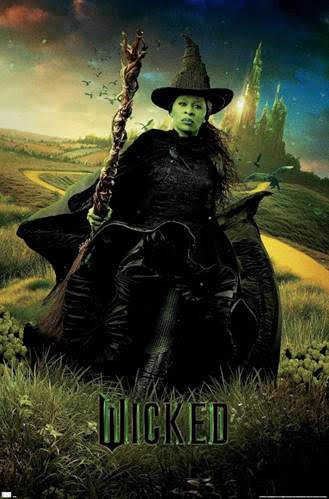
In these two films, we are taken on what Joseph Campbell would identify as the Hero’s Journey. Campbell would suggest a type of journey each of us in our own way has been challenged to do
The first film deals with Elphaba’s journey, being born green and different, causing her a journey of being alone while in a crowd, and later being alone in a “purpose of doing good, earning her the label – bad - for wanting to right a wrong.
We the audience discover, as the character uncovers herself, that there is a reality about her that is underneath and beyond personality and skin color; it is not until she embarks on her journey, moving through phases of what she thinks she needs to be; and what she thinks she wants to be; and what she determines her identity is (call them roles). Roles that Elphaba thinks she has to play, and yet, there is a glimmer of insight about her authentic self she gains through her relationship with Galinda.
That brings us to the end of the first movie but not to the end of questions we have of Elphaba, such as, what happens next after your world of expectations and beliefs are shattered?
This first film (Wicked), also introduces us to Galinda. Who is outwardly beautiful, with all of the trappings of popularity, status, and influence. Someone who seems to have it all. Yet who is also a person alone in the crowd. Early on in the film there are indications in Galinda’s behavior as to the choices she will make, given her chosen role in life; the beliefs, and expectations she has about herself and others, a role - beliefs - and expectations - that keeps her from her true goal and life purpose.
What we find in the first story, are two young women, Elphaba and Galinda drawn together as much by their similarity as they are by their differences.
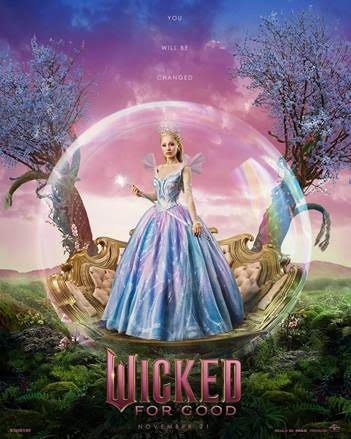
The second film (Wicked for Good) – We find Elphaba, fully developed in a role that does not speak her truth, a role that she soon comes to know as too restrictive and eventually she will have to dissolve, if her true self is to be realized beyond a label of evil and bad.
This second film is where Galinda begins her hero’s journey beyond the role she has always accepted about herself, which is as mechanized as her “bubble” she travels in.
Her transformation happens through situations and encounters between herself and Elphaba. Galinda becomes aware of her persona, and then questions it internally - Who does she want to be? What does she think she wants in life? Followed by what actions to take?
It is not until her expectations and dreams become shattered right in front of her, that Glenda is made to address her “shadow” self, her darkness, as she struggles to find what she really wants. Then how she handles her struggle towards true goodness and light.
Her quest is about her choices; her expectations of situations that do not match up to how her life is actually being lived. She confronts the lies that surround her. When she realizes the repercussions of playing a role rather than being the person she ought to be, and finally her surrender to that which is authentic about herself, that which propels her to do what she must and serve a purpose beyond herself.
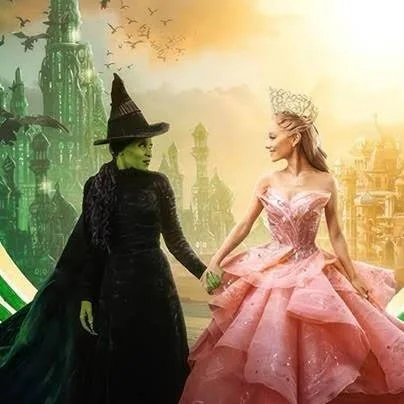
The two films are very different yet complementary in their poignant themes of friendship, working alone and in tandem to reach a higher goal and sense of self.
Which brings me back to a Resolutions or Reframing. Instead of resolutions, maybe this year, try a Reframing challenge, which is to consciously change your perspective of negative thoughts, beliefs, and outcomes that contribute to holding you in certain roles and challenges. Let us rather actively work to change thoughts and habit patterns to align with a more realistic principled view of yourself and situations.
The films gave us clues to move us forward in doing this – Such as to work in tandem with others to flesh out our character roles from our authentic self.
A Prospero's® technique called Releasing the Hidden Splendor©(RHS), I have found to be a helpful means for realignment of beliefs and expectations with the reality of truth and the authentic self.
RHS can be enhanced as a relational orientation tool, when coupled with Group dynamics, this provides you with an abstract understanding and a working hypothesis of Truth that is under and back of the situations and the roles people are casted in.
Used in tandem you will find people can work consciously to challenge and question the shadow self. It is this engagement with others while working on projects and in causes, that people will meet themselves… their own undigested desires, hurt, grief, and feelings of loneliness. This “shadow self”.
Through working with others, and the use of RHS technique they can move past toxic interpersonal relationships - To move to social connections and bonds between people, ranging from brief acquaintances to deep family or romantic ties, vital for human health and development. Relationship connections, built on communication, trust, and empathy, and involving the mutual sharing of emotions and information – that leads to self-disclosure on a scale that produces unpredictable good in their lives… and to allow themselves a future of unpredictable good.
So, are you in?
Happy New Years to You!
Calvin